 |
|
|
|
|
|
RAMANA MAHARSHI, HIS LIFE AND TEACHINGS |
PHOTOS & LINKS |
||||
|
'I' and 'I-I' - A Reader's Query Page 2
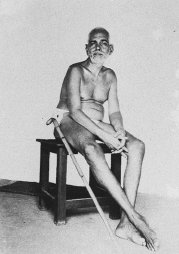
Sri Ramana Maharshi There are two other translations that can add a little evidence to this debate. In the 1920s Lakshmana Sarma translated Ulladu Narpadu into Sanskrit under Bhagavan's supervision. He had to recast each verse several times in order to satisfy Bhagavan that his translation was completely accurate. When verse thirty was translated, Lakshmana Sarma translated talai-sayndidum as 'bows its head in shame'(17) and received Bhagavan's imprimatur on it. Many years later, Major Chadwick translated Upadesa Saram into English and had his manuscript corrected by Bhagavan. In this version Bhagavan approved of the word 'disappears' as a translation of the Sanskrit word nasa in verse twenty.(18) To sum up this linguistic excursion: the verses on 'I-I' that Bhagavan wrote are open to two interpretations. They can be taken either to mean that the 'I-I' is experienced as a consequence of realisation or as a precursor to it. My own view, and I would stress that it is only a personal opinion, is that the evidence points to it being a precursor only. In justification of this view I would say that,
I should like now to raise an interesting question, and, if possible answer it. If the 'I-I' or aham sphurana experience occurs immediately before realisation, and not after it, is there any evidence to show that Bhagavan himself went through such an experience on the day of his own realisation? I think there is, although it is somewhat flimsy. I will begin by quoting one other verse that Bhagavan wrote:
Therefore on diving deep upon the quest 'Who am 'I' and from whence?' thoughts disappear And consciousness of Self then flashes forth As the 'I-I' within the cavity Of every seeker's Heart…(19)
If one adds this to the previous similar quotations I have already cited,(20) there are now four written accounts by Bhagavan that have in common an almost identical theme; as a result of self-enquiry, the 'I'-thought subsides, disappears and is replaced by the 'I-I' 'flashing forth' in the Heart. What authority does Bhagavan have for saying this? I would answer by making the novel suggestion that these writings are autobiographical in nature and that Bhagavan is recording what happened to him on his enlightenment day in 1896. I would support this view by comparing the introductory comments from Vichara Sangraham, answer three, to the well-known account of the death experience which has been printed in many ashram books.
The similarities cannot be ignored. Indeed, since the preamble to the Vichara Sangraham answer is so close to the published accounts of his death experience, it is possible that the remainder of the answer (cited in full earlier in this article) is also autobiographical. If this whole answer is merely a thinly-disguised account of Bhagavan's own Self-realisation, then one can say that he experienced the aham sphurana as a consequence of his enquiry, and that the aham sphurana finally subsided, leaving the full, permanent and sphurana-less experience of the Self. No hint of this can be found in B. V. Narasimhaswami's account of the death experience, but in Krishna Bhikshu's Telugu biography Bhagavan takes up the story of what happened after he had begun his enquiry into the nature of the 'I'.
Now the body is inert, devoid of consciousness, while I am full of awareness. Therefore death is for the inert body. This 'I' is indestructible awareness. The knowledge that remains when the body gives up its affairs and when there are no sensory workings is not sensory knowledge. This aham sphurana is direct knowledge, Self-experience, self-effulgent and not imaginary.(23)
In 1945 Bhagavan confirmed that he had experienced the aham sphurana on the day of his realisation. In a conversation with Swami Rishikeshananda in November that year he remarked: 'In the vision of death I experienced at Madurai, all my senses were numbed, but my aham sphurana was clearly evident to me…'(24) In neither Krishna Bhikshu's nor Anantha Murthy's account does Bhagavan go on to say that the aham sphurana subsided, leaving the full and permanent state of Self-realisation. However, since he on many other occasions asserted that the aham sphurana was a temporary experience and that it must subside and disappear before realisation can take place, it is reasonable to infer that he did in fact experience the sequence of events described in Vichara Sangraham, answer three, on the day of his own realisation. There is one other point that can be mentioned in passing. Though Bhagavan rarely talked about it, there appears, occasionally, to be a cosmological aspect to this usage of the term aham sphurana. On one occasion he said, 'The Supreme Being is unmanifest and the first sign of manifestation is aham sphurana' (25). In what may be an amplification of this unusual statement, Bhagavan once told Devaraja Mudaliar: '
…both sound and light may be implied in the word sphurana. Everything has come from light and sound.'… Explaining how the Self is mere light and how it is both the word or sound and also that out of which word or sound originally came, Bhagavan said, 'Man has three bodies, the gross, the one made of the five elements, the sukshma or subtle one made of manas [mind] and prana, and the jiva. Similarly, even Iswara has three bodies. All the manifest universe is his gross body, light and sound are his subtle body, and the Self is his jiva.'(26)
According to this explanation the aham sphurana can be viewed as the subtle body of Iswara, the source or springboard from which the material world springs or evolves. However, this is somewhat fanciful, being sharply at variance with Bhagavan's mainstream ideas on creation. As a conclusion, it will be appropriate to include an extract from Guru Ramana. In one of his conversations with Bhagavan, S. S. Cohen asked several questions about the nature of the 'I-I'. In his answers, Bhagavan made several interesting comments, many of which are not recorded elsewhere in the Ramana literature.
Mr C: Vivekachudamani speaks of the 'I-I' consciousness as eternally shining in the Heart, but no one is aware of it. Bhagavan: Yes, all men without exception have it, in whatever state they may be - the waking, dreaming and dreamless sleep - and whether they are conscious of it or not. C: In the 'Talks' section of Sat Darshana Bhashya, the 'I-I' is referred to as the Absolute Consciousness, yet Bhagavan once told me that any realisation before Sahaja Nirvikalpa is intellectual. B: Yes, the 'I-I' consciousness is the Absolute. Though it comes before Sahaja, there is in it as in Sahaja itself the subtle intellect; (27) the difference being that in the latter [Sahaja] the sense of forms disappear, which is not the case in the former.
This answer suggests an interesting distinction between the 'I-I' consciousness and kevala nirvikalpa samadhi, both of which, according to Bhagavan, are temporary experiences of the Self. Nirvikalpa means 'no differences', so in kevala nirvikalpa samadhi no names or forms are perceived. However, on the basis of this answer, one can say that forms are still perceived during the 'I-I' experience. In his writings Bhagavan has said that self-enquiry leads to the experience of aham sphurana, and that abidance in the aham sphurana leads on to a full realisation of the sahaja nirvikalpa state. He was less positive about kevala nirvikalpa samadhi, often saying that it was a temporary state, and that the mind would eventually re-emerge from it. He generally tried to discourage devotees from trying to reach this state since he regarded it as something akin to an unproductive detour.(28) One can infer from his remarks and writings that self-enquiry, properly undertaken, bypasses this kevala nirvikalpa state completely and reaches the sahaja state via the alternate route of the aham sphurana experience. Mr. Cohen received confirmation of this as he continued his conversation with Bhagavan:
C: Bhagavan, you said yesterday that there exists in the human body a hole as small as a pinpoint, from which consciousness always bubbles out to the body. Is it open or shut? B: It is always shut, being the knot of ignorance which ties the body to consciousness. When the mind drops away in the temporary Kevala Nirvikalpa it opens but shuts again. In Sahaja it remains always open. C: How is it during the experience of 'I-I' consciousness? B: This consciousness is the key which opens it permanently.
This opening process may be the same one that was described by Bhagavan in his letter to Ganapati Muni, which I quoted earlier. Part of it read: 'When the mind having pure sattva as its characteristic remains attending to the aham sphurana, which is the sign of the forthcoming direct experience of the Self, the downward-facing Heart becomes upward-facing and remains in the form of That.' If 'the Heart becomes upward-facing' is the equivalent of this small consciousness-emitting hole opening, then this is another instance of Bhagavan saying that abidance in the aham sphurana is the way to make the Heart open permanently. When the Heart is permanently open, the world, which was previously assumed to be external, is experienced not as separate names and forms, but as one's own Self, as the immanent Brahman. In nirvikalpa samadhi, according to Bhagavan, the Heart temporarily opens to admit the mind, but then closes again. Thus the nirvikalpa experience of the Self is both limited (in so far as it is temporary) and 'internal'. Because the Heart remains closed, the sahaja experience of the world being Brahman is absent. There is merely an internal awareness of one's real nature that lasts as long as the duration of the samadhi. As mentioned before, in the aham sphurana experience, external awareness is retained, but names and forms continue to be perceived as names and forms until the 'I' finally dies in the Heart. One final point needs to be stressed. In Ulladu Narpadu, Upadesa Undiyar and Vichara Sangraham Bhagavan makes the point that it is self-enquiry that leads to aham sphurana. Nowhere is it mentioned in these texts that other methods lead to this state. This point is made again in the concluding section of Mr. Cohen's talk with Bhagavan:
C: How to reach that Centre where what you call the ultimate consciousness- the 'I-I' - arises? Is it by simply thinking 'Who am I?' B: Yes, it will take you up. You must do it with a calm mind - mental calmness is essential. C: How does that consciousness manifest when that Centre - the Heart - is reached? Will I recognise it? B: Certainly, as pure consciousness, free from all thought. It is pure unbroken awareness of your own Self, rather of Being - there is no mistaking it when pure. C: Is the vibratory movement of the Centre felt simultaneously with the experience of Pure Consciousness, or before, or after it? B: They are both one and the same. But sphurana can be felt in a subtle way even when meditation has sufficiently established and deepened, and the ultimate consciousness is very near, or during a sudden fright or great shock, when the mind comes to a standstill. It draws attention to itself, so that the meditator's mind, rendered sensitive by calmness, may become aware of it, gravitate toward it, and finally plunge into it, the Self. C: Is the 'I-I' consciousness Self-realisation? B: It is a prelude to it: when it becomes permanent Sahaja it is Self-realisation, Liberation. (29)
Page: 1 2
(17) Revelation by 'Who', 1980 ed., v. 35. Because of additional verses included at the beginning of the text, Who's numbering system differs from other translators. Verse 30 becomes verse 35 in his version.
(18) The Poems of Sri Ramana Maharshi, by Major Chadwick, 3rd ed., p. 15. The original notebook with Bhagavan's handwritten corrections is kept in the ashram archives.
(19) Atma Vidya Kirtanam, v. 2, taken from Collected Works.
(20) Ulladu Narpadu, v. 30, Upadesa Undiyar, vv. 19 and 20, Vichara Sangraham, answer 3.
(21) Vichara Sangraham, answer 3.
(22) Ramana Maharishi and the Path of Self Knowledge, ch. 2. In an alternative version (The Mountain Path, 1982, p. 68) Bhagavan asks himself, just prior to his Self-realisation, 'What was this ''I''? Is it the body? Who called himself the ''I''?' This version, in which such a definite act of self-enquiry takes place, is even closer to the Vichara Sangraham version.
(23) Ramana Leela, 7th ed., pp. 20-21.
(24) The Life and Teachings of Sri Ramana Maharshi by T. S. Anantha Murthy, 1972, ed., p. 6-7.
(25) Talks with Sri Ramana Maharshi, talk no. 518.
(26) Day by Day with Bhagavan, 24th March, 1945. These remarks are part of Bhagavan's explanation of the word sphurana in question three of Vichara Sangraham.
(27) When Bhagavan mentioned that the subtle intellect remains in the sahaja state, he was referring to the vijnanamayakosa, or 'the sheath of pure intellect'. He would occasionally say that the jnani keeps in contact with the world via this sheath although such statements do not sit well with his assertion that the jnani has no mind. See Guru Ramana, 7th ed., pp. 100-101 for further details.
(28) See, for example, Talks with Sri Ramana Maharishi, no. 54, in which Bhagavan notes that one can get stuck in nirvikalpa samadhi for years without making any progress.
(29) Guru Ramana, 1974 ed. pp. 81-3. |
|