David Godman is best known for his anthology of Ramana Maharshi’s writings, Be As You Are, which has become a popular reference book on the great sage’s teachings. But few people know that David has written nine other books, and each one is equally remarkable in its own way. Two of these books have just come out, providing a good excuse for an interview. Since David lives in Tiruvannamalai and the editor of this website lives in New York, the interview was conducted by e-mail.
[This interview was conducted around 2001. Some of the information is out of date. I have updated some of the answers I gave. When I do this, I put the new material in italics inside square brackets.]
Rob Sacks: You have just brought out two new books on Ramana Maharshi. Can you tell me something about them?
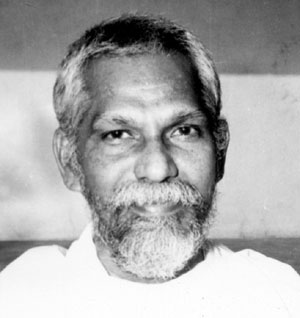
Annamalai Swami in his Palakottu room
David Godman: In the late 1980s I began to collect first-person accounts by people who had spent time with Ramana Maharshi. It was my intention to make an anthology of accounts that hadn’t been published before. To find original material I did extensive research on books that had appeared in various Indian languages but not in English. I also found some good material written in English that had never been published. At some point during this research I went to see Annamalai Swami, a devotee of Sri Ramana who had moved intimately with him for many years. His account proved to be so interesting and so long, I ended up doing a whole book just about him.
Then I went to Lucknow to interview Papaji. His story fascinated me so much, I spent four years in Lucknow and eventually wrote a massive 1,200-page biography.
With Papaji in Haridwar, 1993
The original project got put on the back burner, and I only came back to it about a year ago. I have changed my original criteria. I am now using some material that has been published before. However, since most of this material is rarely sold outside India, I think non-Indian readers of these books, even devotees of Sri Ramana, will find that most of the material is new to them.
Rob Sacks:What made you decide to take this particular approach to Sri Ramana?
David Godman: Sri Ramana is all things to all people. There is no standard Ramana Maharshi who is the same for all people. People who approached him brought their minds with them, and Bhagavan, being a non-person with no mind of his own, magnified and reflected back all this incoming mental energy. So, different people saw him and experienced him in many different ways. If I wanted to write about Sri Ramana myself, I would have to put my own editorial overlay on top of all these differing experiences and impressions. So, I thought, ‘Let people speak for themselves. Let people explain who their particular Ramana is.’
There is a fictional detective, Hercule Poirot, who appears in many of Agatha Christie’s books. In one story, when he was completely stuck, he just started talking to everyone who was involved, and spent many hours just listening to what they had to say. Poirot’s theory was, ‘If you let people talk about themselves for long enough, sooner or later they give themselves away’.
This was my approach. I didn’t want to edit or shorten anyone’s story. On the contrary, I wanted to make it as detailed as possible. So, I just let them talk and say what they wanted to say. If you give someone thirty pages to talk or write about their relationship with Sri Ramana, they have to reveal who they are in a very intimate way. This was my aim: to have a gallery of intimate portraits of Sri Ramana, each one drawn lovingly by a person who had a personal and very unique perspective on this great being.
Rob Sacks: Could you describe one of your favorite sections from either of these books?
David Godman: When I made the first drafts of some of these chapters back in the 1980s, I circulated copies to all my friends in Tiruvannamalai. I asked everyone to give marks out of ten on how interesting they found each account. Some chapters that were given ten by one person would get zero from someone else. This illustrates what I was just saying: everyone has a different idea of who Sri Ramana is, and because people relate to him in different ways, they react differently to stories about him. My favorites were not so popular with many of my friends.
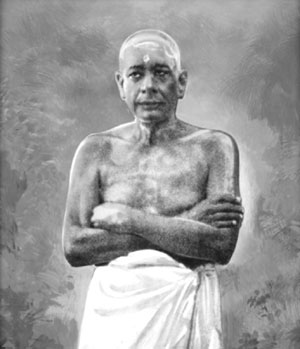
Sivaprakasam Pillai
It’s fashionable nowadays to be very positive about one’s spiritual experiences. People like to jump up and down and exclaim, ‘I’m free! I’m free!’ I prefer the refreshing honesty of a devotee, Sivaprakasam Pillai, who, after fifty years of being with Sri Ramana, was still lamenting about his faults and his lack of progress.
This is the person who first got Bhagavan to record his teachings on self-enquiry in 1901. I admired his honesty, his humility and his integrity in admitting that he still couldn’t control his mind. I also enjoyed some of the teachings of Sri Ramana that were recorded by Sadhu Natanananda, whose account also proved to be not too popular with my friends. This is an extract that I particularly liked:
A certain lady who had a lot of devotion performed a traditional ritual for worshipping sages whenever she came into Bhagavan’s presence to have darshan. She would prostrate to Bhagavan, touch his feet and then put the hands that had touched Bhagavan’s feet on her eyes. After noticing that she did this daily, Bhagavan told her one day:
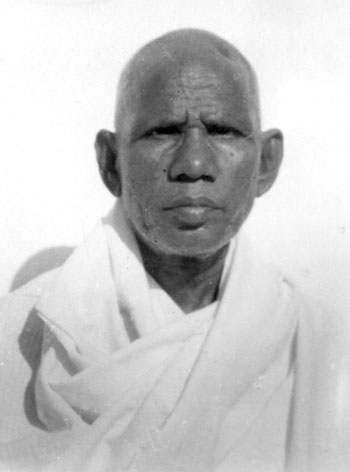
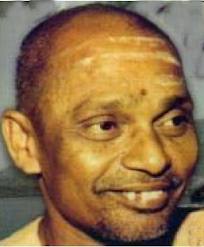
Sadhu Natanananda
Only the Supreme Self, which is ever shining in your heart as the reality, is the Sadguru. The pure awareness, which is shining as the inward illumination ‘I’, is his gracious feet. The contact with these [inner holy feet] alone can give you true redemption. Joining the eye of reflected consciousness [chitabhasa], which is your sense of individuality [jiva bodha], to those holy feet, which are the real consciousness, is the union of the feet and the head that is the real significance of the word ‘asi‘ [“are”, as in the mahavakya ‘You are That’]. As these inner holy feet can be held naturally and unceasingly, hereafter, with an inward-turned mind, cling to that inner awareness that is your own real nature. This alone is the proper way for the removal of bondage and the attainment of the supreme truth.
I appreciate and applaud anyone who has devotion to Bhagavan’s form, but at the same time I love the purity of Bhagavan’s advaitic response to this woman.
Rob Sacks: Can we backtrack a little? Can you tell me something about your own background, some details of your family and how you came to be interested in Ramana Maharshi?
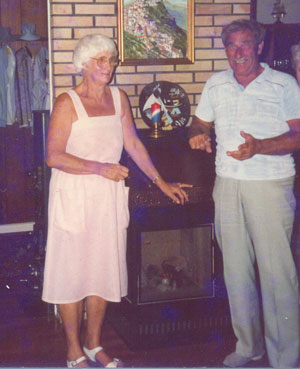
My parents in the Spanish home in the 1980s
David Godman: I was born in 1953 in Stoke-on-Trent, a British city of about 300,000, located about halfway between Birmingham and Manchester. My father was a schoolmaster and my mother was a physiotherapist who specialised in treating physically handicapped children. Both of my parents are dead.
I have one sister who is a year older than me. She is a former professional mountaineer who now teaches mountain and wilderness skills and occasionally leads groups to exotic and inaccessible places.
My younger sister, used to teach in a college in England. Nowadays, though, she spends most of her time assessing the quality of education on offer in different colleges.
[This information is now out of date. Geraldine and her husband Martin founded a travel company a few years ago. They take clients to exotic places and teach them photography while they are there. Megan now inspects and assesses schools and colleges for the British government and also works as a consultant to educational institutions that want advice on how to do well on government inspections. Her husband Michael is a partner in an accountancy firm in Kent.]
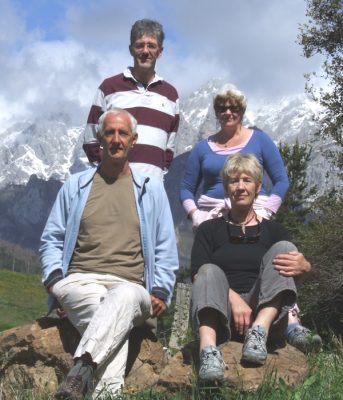
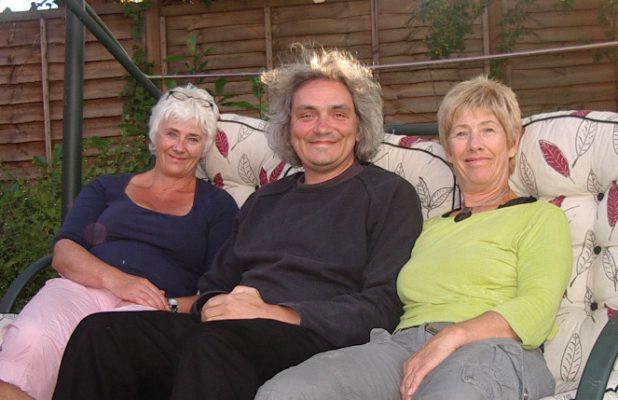
Standing at the back are my younger sister Megan and her husband Michael. Geraldine, my elder sister is sitting next to me. The photo was taken on a family holiday in North-West Spain.
I was educated at local schools and in 1972 won a place at Oxford University, where I did very little academic work, but had an enormous amount of fun. Sometime in my second year there I found myself getting more and more interested in Eastern spiritual traditions. I seemed to have an insatiable hunger for knowledge about them that resulted in massive bookstore bills, which I couldn’t really afford, but not much satisfaction. Then, one day, I took home a copy of Arthur Osborne’s The Teachings of Ramana Maharshi in his Own Words.
Reading Ramana’s words for the first time completely silenced me. My mind stopped asking questions, and it abandoned its search for spiritual information. It somehow knew that it had found what it was looking for. I have to explain this properly. It wasn’t that I had found a new set of ideas that I believed in. It was more of an experience in which I was pulled into a state of silence. In that silent space I knew directly and intuitively what Ramana’s words were hinting and pointing at. Because this state itself was the answer to all my questions, and any other questions I might come up with, the interest in finding solutions anywhere else dropped away. I suppose I must have read the book in an afternoon, but by the time I put it down it had completely transformed the way I viewed myself and the world. The experiences I was having made me understand how invalid were the academic techniques of acquiring and evaluating knowledge. I could see that the whole of academia was based on some sort of reductionism: separating something big into its little component parts, and then deriving conclusions about how the ‘big something’ really worked. It’s a reasonable approach for comprehending mechanical things, such as a car engine, but I understood — and knew by direct experience — that it was a futile way of gaining an understanding of oneself and the world we appear to be in.
My two sisters with Martin, Geraldine’s husband
When I went through my academic textbooks after having these experiences, there was such a massive resistance both to their contents and to the assumptions that lay behind them, I knew I could no longer even read them, much less study them in order to pass exams. It wasn’t an intellectual judgement on their irrelevance; it was more of a visceral disgust that physically prevented me from reading more than a few lines. I dropped out in my final year at Oxford, went to Ireland with my Ramana books, and spent about six months reading Ramana’s teachings and practising his technique of self-enquiry. I had just inherited a small amount from my grandmother, so I didn’t need to work that year.
I rented a small house in a rural area, grew my own food, and spent most of my time meditating. This was 1975. At the end of that year my landlady reclaimed her house and I went to Israel. I wanted to go somewhere sunny and warm for the winter, and then return to Ireland the following spring. I worked on a kibbutz on the Dead Sea and while I was there decided I could have a quick trip to India and Ramanasramam before I went back to Ireland. I figured out the costs and realised I couldn’t afford it unless another £200 appeared from somewhere. I decided that if Bhagavan wanted me to go to India, he would send me the money. Within a week I received a letter from my grandmother’s lawyer saying that he had just found some shares that she had owned, and that my share of them would be £200. I came to India, expecting to stay six weeks, and have been here more or less ever since.
Rob Sacks: I’ve always wondered about your name. Is Godman your birth name or did you change it?
David Godman: It’s my family name. I never had any desire to take a new name, and no one has ever tried to give me one.
Rob Sacks: You said that you spent six months practicing self-enquiry based on your reading of Sri Ramana’s books. Were you able to get a good understanding of the method from your reading? I ask because this seems to be difficult for most people. Did you need to modify your understanding later when you went to Sri Ramanasramam?
Arthur Osborne
David Godman: I did find it hard to practise self-enquiry merely by reading books simply because I did not have access to much material. I had at that time only managed to find Arthur Osborne’s three books on Ramana. Though they explained most aspects of the teachings quite well, I don’t think that Osborne had a good understanding of self-enquiry. He seemed to think that concentrating on the heart-center on the right side of the chest while doing self-enquiry was an integral part of the process. When I later read Bhagavan’s answers in books such as Talks with Sri Ramana Maharshi and Day by Day with Bhagavan, I realised that he specifically advised against this particular practice. Overall, though, I got a good grounding from these books. I had a passion to follow the practice and a deep faith in Bhagavan. I think that this elicited grace from Bhagavan and kept me on the right path. If the attitude is right and if the practice is intense enough, it doesn’t really matter what you do when you meditate. The purity of intent and purpose carries you to the right place.
Rob Sacks: If someone wants to learn self-enquiry, what should they read?
David Godman: I don’t know what book I would recommend to new people who want to start self-enquiry. Be As You Are is certainly a good start since it was designed for Westerners who have had no previous exposure to Bhagavan and his teachings.
Sadhu Om
There is also a book by Sadhu Om: The Path of Sri Ramana Part One. It is a little dogmatic in places but it covers all the basic points well. Self-enquiry is a bit like swimming or riding a bicycle. You don’t learn it from books. You learn it by doing it again and again till you get it right.
Rob Sacks: Could you briefly describe what your life has been like in Tiruvannamalai? What work have you done at Sri Ramanasramam?
David Godman: I spent my first eighteen months just meditating, practising self-enquiry, and occasionally walking round Arunachala. In 1978 I began to do voluntary work for Sri Ramanasramam. I looked after their library from 1978 to 1985, edited their magazine for a short period of time, and from 1985 onwards did research for my various books. In the later 1980s and early 90s I also devoted a considerable amount of time to looking after Lakshmana Swamy and Saradamma’s garden.
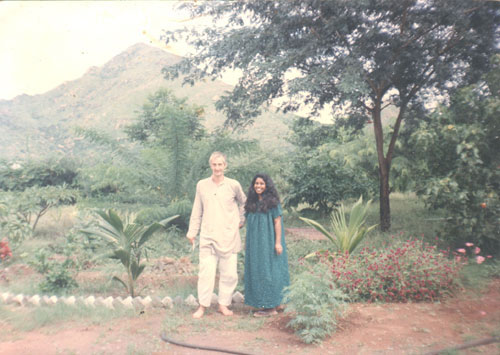
With Saradamma in her garden, early 1990s
They bought land in Tiruvannamalai in 1988 and I ended up helping to develop it. In 1993 I went to Lucknow and spent four years with Papaji, where I wrote Nothing Ever Happened. Since my return to Tiruvannamalai in 1997 I have been writing and researching new books on Ramana.
Rob Sacks: How have you supported yourself in India all these years?
David Godman: I didn’t. Grace supported me. I have found that if you give all your time to God and his work, then he looks after you. I came here with $500 in 1976. I didn’t earn money for twenty years, but I always had enough to live on. Until I left Lucknow I gave the proceeds from all my books to the various organisations that supported me while I was writing them.
When I first came to Arunachala I fell in love with the place and wanted to stay as long as I could. I knew I didn’t have much money, but I wanted to make it last as long as possible. There was a meter ticking away in my head: I have so much money, I am spending so much per day, and that means I have so many more days here. Those numbers, those equations were there all the time. Then, one day, as I was doing pradakshina of Arunachala, it all dropped away. It wasn’t a mental decision. I stopped walking, turned, and faced the hill. I knew in that moment that whatever power had brought me here would keep me here until its purpose was finished, and that when it was time to go, it wouldn’t matter if I was a millionaire or not, I would have to leave. From then on I stopped caring about money. In the period that I was worrying about money, all I did was spend. When I stopped caring, complete strangers would come up to me and give me money. Whenever I needed money, money just appeared out of nowhere.
Rob Sacks: Can you give me an example of how this worked?
David Godman: When I volunteered to look after Lakshmana Swamy’s land in the late 80s, I had about $20 to my name.
Somebody in Canada whom I had spoken to for about ten minutes two years before got out of bed and suddenly felt that he should give me some money. He sent me $1,000, which was enough to get the garden going. I lived like that for years. When you work for Gurus, God pays the bills. That’s my experience anyway. It was Papaji who encouraged me to start working for myself. He himself was a householder who spent decades supporting his family. He generally wouldn’t let anyone give up his or her worldly life until retirement age, which in India is around 55. When I started work on Nothing Ever Happened, I assumed that all the proceeds would go to him, or to some organisation that was promoting his teachings. At some point during the research though, he let me know that he wanted me to accept royalties from the sale of the book.
Nowadays, I am not supported by any institution, so I publish my own books and live off the proceeds, which I have to say are minimal. I can live fairly comfortably in a third world country such as India, but if I tried to live in America on what I earn from my books, I would be several thousand dollars a year below the poverty line.
Rob Sacks: What effect do you feel in the presence of Arunachala?
David Godman: Arunachala brought me here in the same way it brought Ramana here. And it has kept me here for most of the last 25 years.
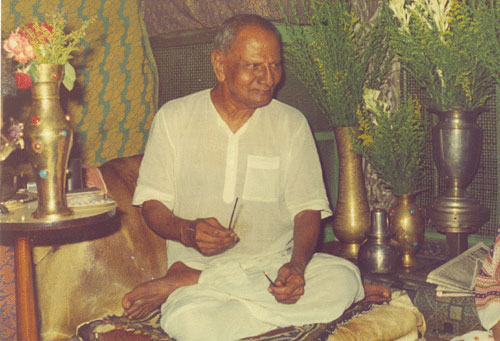
Nisargadatta Maharaj in his room
I have occasionally left to be with teachers in other places: Nisargadatta Maharaj in Bombay, Lakshmana Swamy in Andhra Pradesh, Papaji in Lucknow, but Arunachala has always brought me back here afterwards. It’s my spiritual center of gravity. I can make an effort to be somewhere else if I feel I would spiritually benefit from it, but when I stop making that effort, the natural pull of Arunachala brings me back here again. It’s the only place in the world that I feel truly at home.
Arunachala has been attracting people for well over 1,500 years. Ramana liked to quote a saint of about 500 years ago who wrote in one of his verses, ‘Arunachala, you draw to yourself all those who are rich in jnana tapas‘. Jnana tapas can be translated as the extreme efforts made by those who are in search of liberation.
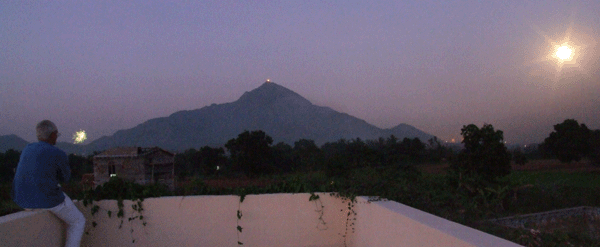
Arunachala at Deepam, taken from my roof.
There are dozens of teachers nowadays who tour the world touting their experiences and their teachings. Many of them trace their lineage back to Ramana Maharshi via Papaji. And where did Ramana Maharshi’s power and authority come from? From Arunachala, his own Guru and God. He explicitly stated that it was the power of Arunachala that brought about his own Self-realisation. He wrote poems extolling its greatness, and in the last fifty-four years if his life, he never moved more than a mile and a half away from its base. So, it is the power of Arunachala that is the true source of the power that now appears as ‘advaita messengers’ all over the world.
For me, this is the world’s great power spot. Arunachala has brought about the liberation of several advanced seekers in the past few centuries, and its radiant power remains even today as a beacon for those who want to find out who they really are.
Rob Sacks: Have there been living people whom you regarded as your Gurus, or who had an especially strong impact on you spiritually?
Lakshmana Swamy
David Godman: I think the four key spiritual figures would be Lakshmana Swamy, Saradamma, Nisargadatta Maharaj and Papaji. I have to include Ramana Maharshi on this list, even though I never met him while he was alive. I feel him as strongly as I have felt any other teacher. The Self that took the form of Ramana Maharshi is my Guru. He lit the lamp of enlightenment in the Heart of a few of his devotees, and when I sit in the presence of these beings I am receiving the luster, the light of Ramana Maharshi through them. So I will not say that my Guru has a particular form. I will say that the light of Arunachala became manifest in Ramana, and through him it was passed on to Lakshmana Swamy, Papaji, and Saradamma. When I bask in their light, I am basking in the living, transmitting light of Arunachala-Ramana.
Nisargadatta does not belong to this lineage, but he was an enormously beneficial presence in my life in the late 1970s and early 80s. I used to go and see him as often as I could. He repeatedly told me ‘you are consciousness’ and on a few rare, glorious occasions I understood what he was talking about. He was not simply giving me information; he was instead describing my own state, my own experience in that moment. That was his technique. He would talk endlessly about the Self until you suddenly realised directly, ‘Yes, this is what I am right now’.
Rob Sacks: Have you used any practices in addition to those associated with Sri Ramana?
David Godman: No. From the moment I first encountered Bhagavan and his teachings in the 1970s I have never found myself attracted to any other teachings or practices.
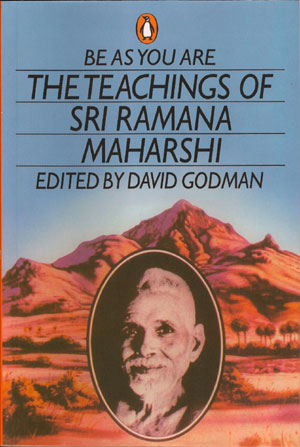 David Godman is best known for his anthology of Ramana Maharshi’s writings, Be As You Are, which has become a popular reference book on the great sage’s teachings. But few people know that David has written nine other books, and each one is equally remarkable in its own way. Two of these books have just come out, providing a good excuse for an interview. Since David lives in Tiruvannamalai and the editor of this website lives in New York, the interview was conducted by e-mail.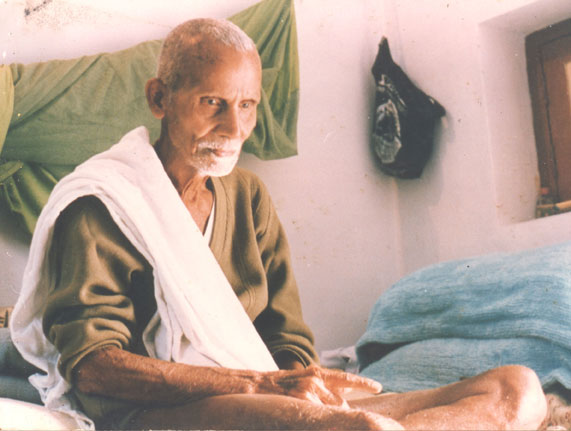

 There is a fictional detective, Hercule Poirot, who appears in many of Agatha Christie’s books. In one story, when he was completely stuck, he just started talking to everyone who was involved, and spent many hours just listening to what they had to say. Poirot’s theory was, ‘If you let people talk about themselves for long enough, sooner or later they give themselves away’.