Sometime last year (this was written in the early 1980s) I received a letter from Professor James E. Royster of Cleveland State University, USA, which contained the following interesting question:
My reason for writing is to raise a question with you that has long puzzled me. I have been reading Ramana Maharshi for about twenty years and frequently find him using the expression. ‘I-I’ but I’m not clear on his meaning. Why ‘I-I’ rather than simply ‘I’? I can think of many possible meanings but I am not at all sure what Ramana intended. Is it to suggest that the sense of separate self (or self-consciousness) arises only in relationship to another sense of separate self? Or that the individual atman is derived from (“subtracted” from) the Absolute Atman, Brahman Nirguna? Does ‘I-I’ refer to the ego or the Universal Self? My guesses and interpretations go on and on. If you can shed some light on this issue I will be most appreciative. Perhaps there has been an article in The Mountain Path or elsewhere that takes up this question.
This question has not, to my knowledge, been discussed in any great detail in either The Mountain Path or any other ashram publication. I therefore sent the following detailed reply to the professor. Since I suspect that some devotees may disagree with some of my conclusions, I should say in advance that this is not intended to be a definitive explanation. It merely reflects my own views.
* * *
Bhagavan never used the term ‘I-I’ to denote the mind, the ego or the individual self, nor did he intend it, as Professor Royster speculates, to indicate that there is any relationship between the individual ‘I’ and the Self. On the contrary, Bhagavan makes it clear on many occasions that ‘I-I’ is an experience not of the ego but of the Self. Verse thirty of Ulladu Narpadu is quite emphatic about this:
Questioning ‘Who am I?’ within one’s mind, when one reaches the Heart, the individual ‘I’ sinks crestfallen, and at once reality manifests itself as ‘I-I’. Though it reveals itself thus, it is not the ego ‘I’ but the perfect being the Self Absolute. (Truth Revealed, v. 30, 1982 ed.)
Verses nineteen and twenty of Upadesa Undiyar describe the same process in almost identical terms:
19 ‘Whence does the ‘I’ arise?’ Seek this within. The ‘I’ then vanishes. This is the pursuit of wisdom.
20 Where the ‘I’ vanished, there appears an ‘I-I’ by itself. This is the infinite. (Upadesa Saram translated by B. V. Narasimhaswami)
Although Bhagavan is here clearly equating the experience of ‘I-I’ with the experience of the Self, one should be wary of jumping to the conclusion that he is saying in these three verses that the ‘I-I’ experience occurs after the final realisation of the Self. Why? Because on many other occasions Bhagavan told devotees that the ‘I-I’ experience was merely a prelude to realisation and not the realisation itself. I shall return to the question of whether the ‘I-I’ experience can be equated with Self-realisation later in this article, but first I feel that it would be more profitable to examine some of the quotations in which Bhagavan gave detailed descriptions of the ‘I-I’.
Bhagavan frequently used the Sanskrit phrase aham sphurana to indicate the ‘I-I’ consciousness or experience. Aham means ‘I’ and sphurana can be translated as ‘radiation, emanation, or pulsation’. When he explained what this term meant, he indicated that it is an impermanent experience of the Self in which the mind has been temporarily transcended. This distinction between the temporary experience of the ‘I-I’ and the permanent state of Self-realisation that follows it is well brought out in the question-and-answer version of Vichara Sangraham (Self-Enquiry):
Therefore, leaving the corpse-like body as an actual corpse and remaining without even uttering the word ‘I’ by mouth, if one now keenly enquires, ‘What is it that rises as ‘I’? then in the Heart a certain soundless sphurana, ‘I-I’, will shine forth of its own accord. It is an awareness that is single and undivided, the thoughts which are many and divided having disappeared. If one remains still without leaving it, even the sphurana – having completely annihilated the sense of the individuality, the form of the ego, ‘I am the body’ – will itself in the end subside, just like the flame that catches the camphor. This alone is said to be liberation by great ones and scriptures.
This is from question three of Vichara Sangraham, translated by Sadhu Om, and taken from page 98 of The Mountain Path, 1982. The word order has been slightly changed in this version.
This answer can be taken to be an amplification of and a commentary on the three verses already quoted, for the same sequence of events is described, but at greater length: after the source of the ‘I’-thought is sought for, the ‘I’-thought subsides, disappears and is replaced by the aham sphurana. What this longer quotation makes clear is that even this sphurana of ‘I-I’ has to subside before the final and permanent stage of Self-realisation is attained.
Bhagavan’s use of the word sphurana in this quotation once puzzled Devaraja Mudaliar. He therefore asked Bhagavan about it and received a detailed, illuminating answer:
Devaraja Mudaliar
I have always had doubt about what exactly the word sphurana means [in question three of Vichara Sangraham]. So I asked Bhagavan and he said, ‘It means… ‘Which shines or illuminates’’.’ I asked, ‘Is it not a sound we hear?’ Bhagavan said, ‘Yes, we may say it is a sound we feel or become aware of’. He also referred to the dictionary and said, ‘The word means “throbbing”, “springing on the memory”, “flashing across the mind”. Thus both sound and light may be implied in the word sphurana. Everything has come from light and sound.’ I asked Bhagavan what it is that ‘shines’, whether it is the ego or the Self. He said that it was neither the one nor the other, but something in between the two, that it is something that is a combination of the ‘I’ (Self) and the ‘I’-thought (ego) and that the Self is without even this sphurana. (Day by Day with Bhagavan, 23rd April, 1945)
Another more philosophical explanation of the aham sphurana and ‘I-I’ can be found in one of the later answers of Vichara Sangraham:
D: It was stated [in your previous answer] that Brahman is manifest as the Self in the form of ‘I-I’ in the Heart. To facilitate an understanding of this statement, can it be still further explained?
M: Is it not within the experience of all that during deep sleep, swoon etc., there is no knowledge whatsoever, that is, neither Self-knowledge nor other knowledge. Afterwards, when there is experience of the form ‘I have woken up from sleep’ or ‘I have recovered from swoon’ – is that not a mode of specific knowledge that has arisen from the aforementioned state? This specific knowledge is called vijnana. This vijnana becomes manifest only as pertaining either to the Self or the not-Self, and not by itself. When it pertains to the Self it is called true knowledge, knowledge in the form of that mental mode whose object is the Self or knowledge which has for its content the impartite [Self], and when it relates to the not-Self it is called ignorance. The state of this vijnana when it pertains to the Self and is manifest in the form of the Self is said to be the aham sphurana. This sphurana cannot remain independently, leaving the Reality. It is this sphurana that serves as the mark for the direct experience of the Real. Yet this by itself cannot constitute the state of being the Real. That, depending on which this manifestation takes place, is the basic Reality, which is also called prajnana [pure consciousness]. The Vedantic text ‘prajnanam brahma’ [Brahman is pure consciousness] teaches the same truth.
This has been taken from Vichara Sangraham, question and answer no. 32. Part of the translation has been taken from the booklet Self-Enquiry and part from The Mountain Path, 1982, p. 98.
This is a most interesting answer because it can also serve as a commentary on the first half of one of Bhagavan’s most famous verses. In Sri Ramana Gita, chapter two, verse two, Bhagavan states that, ‘In the interior of the heart-cave Brahman alone shines in the form of Atman with direct immediacy as I, as I.’ (Sri Ramana Gita, 6th ed.)
Although this Ramana Gita verse, and particularly its second half, has been extensively discussed in the Ramana literature, no commentators, so far as I am aware, have mentioned Bhagavan’s own written explanation in Vichara Sangraham of the ‘I-I’ shining in the Heart.
At this point in the discussion an interesting phenomenon needs to be commented on. In his writings (Upadesa Undiyar, vv. 19 and 20, Ulladu Narpadu, v. 30, and Sri Ramana Gita, ch. 2, v. 2) Bhagavan has made several relatively brief statements in which he equates the ‘I-I’ experience with the Self. At first sight they appear to be descriptions of the state of Self-realisation, but when they are read in conjunction with the long explanations of the ‘I-I’ that can be found elsewhere in his writings (Vichara Sangraham, answers 3 and 30) and in his verbal comments, it is possible to see in these verses a description of the impermanent ahamsphurana rather than the permanent state of realisation. This is an unusual interpretation, but I believe it to be a sustainable one. However, I would not go so far as to say that it is the only legitimate way of interpreting these verses.
In the previous quotation from Vichara Sangraham the ‘I-I’ is defined as being a clear knowledge (vijnana) of the Self in which the mind, still existing, clings tightly to its source and is permeated by emanations of ‘I’-ness radiating from the Self.
Ganapati Muni may have had this particular answer in mind when he wrote to Bhagavan and asked the following question: ‘Is abidance in vijnana a means for gradually attaining the perfect, or is it not? If it is not certainly a means for that, then for what purpose is it?’
In his reply Bhagavan repeated the relevant parts of the answer from Vichara Sangraham but he also added some remarks on how self-enquiry leads to aham sphurana and how abidance in aham sphurana, or ‘I-I’, leads to Self-realisation:
The ‘I’-thought which rises in this manner [by catching hold of something] appears in the form of the three gunas, and of these three the rajas and tamas aspects cling to and identify with the body. The remaining one, which is pure sattva, is alone the natural characteristic of the mind, and this stands clinging to the reality. However, in the pure sattvic state, the ‘I’-thought is no longer really a thought, it is the Heart itself… The state in which the pure sattva mind shines clinging to the Self is called aham sphurana…The source to which this sphurana clings alone is called the reality or pure consciousness… When the mind, having pure sattva as its characteristic, remains attending to the aham sphurana, which is the sign of the forthcoming direct experience of the Self, the downward-facing Heart becomes upward-facing and remains in the form of That. This aforesaid attention to the source of the aham sphurana alone is the path. When thus attended to, Self, the reality, alone will remain shining in the centre of the Heart as I-am-I. (‘Sri Bhagavan’s Letter to Ganapati Muni,’ The Mountain Path, 1982, pp. 95-101)
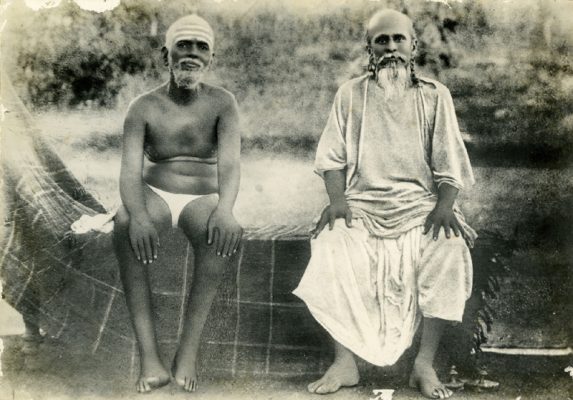
Bhagavan and Ganapati Muni at Skandashram
The quotations given so far should make it clear what Bhagavan was referring to when he spoke of the ‘I-I’ experience, but they fail to address one of Professor Royster’s principal questions: why does Bhagavan use the term ‘I-I’ rather than ‘I’? The term ‘I’ is clearly inadequate and confusing since it denotes either the Self or the ego rather than the aham sphurana which is, as Bhagavan says, ‘neither the one nor the other’. A. R. Natarajan in his commentary on Sri Ramana Gita suggests that ‘to denote the continuous nature of the throb of consciousness, Ramana repeats the words as “I-I”.’ (Sri Ramana Gita, by A. R. Natarajan, p. 20) This is certainly plausible. An alternative explanation, suggested by Sadhu Om, (Upadesa Undiyar, p. 20) can be derived from the rules of Tamil grammar. In simple Tamil sentences the present tense of the verb ‘to be’ is usually omitted. Thus, the expression ‘nan-nan’ (‘I-I’ in Tamil) would generally be taken to mean ‘I am I’ by a Tamilian. This interpretation would make ‘I-I’ an emphatic statement of Self-awareness akin to the biblical ‘I am that I am’ which Bhagavan occasionally said summarised the whole of Vedanta. Bhagavan himself has said that he used the term ‘I-I’ to denote the import of the word ‘I’. This explanation appears in both Upadesa Undiyar (verse 21) and in the talks that precede Sat Darshana Bhashya. (Sat Darshana Bhashya, 7th ed. p.iii)
Whichever explanation one chooses, either these or others, one should avoid those which postulate that the experience is called ‘I-I’ because it radiates in discrete pulses, for Bhagavan was quite emphatic that the experience was continuous and unbroken. For example, in the essay version of Vichara Sangraham he wrote: ‘Underlying the unceasing flow of varied thoughts there arises the continuous unbroken awareness, silent and spontaneous, as ‘I-I’ in the Heart.’ (Vichara Sangraham, essay version, ch. 1)